Buying farm or land property in East Tennessee means confirming the parcel's Greenbelt tax status, getting a perc test before assuming a septic system will work, verifying legal deeded road access, and exploring USDA Farm Service Agency loans, since conventional banks often require 20-50% down on raw land.
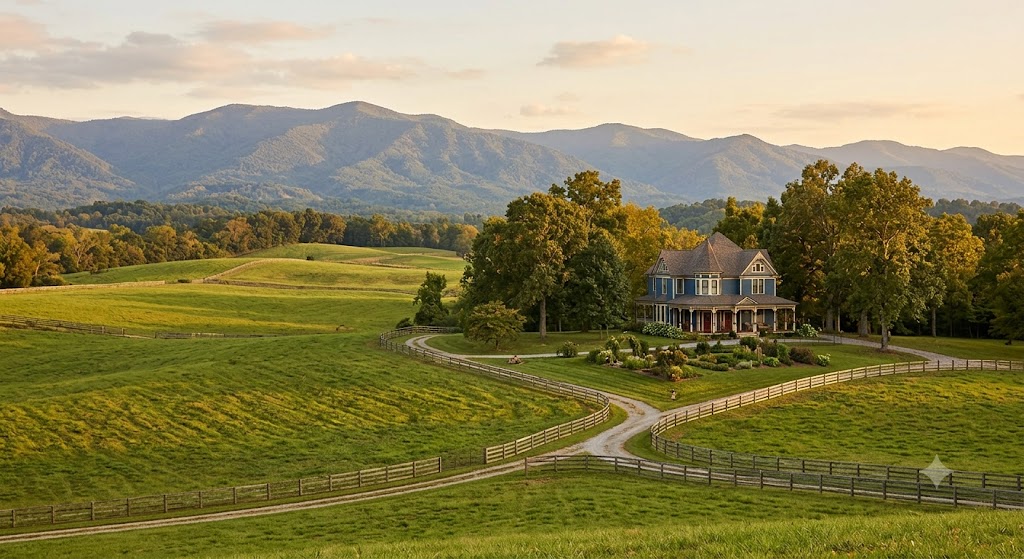
Some of our favorite showings aren't houses at all. They're a truck ride down a gravel lane in Monroe or Blount County, acreage stretching out on both sides, and a buyer who's been dreaming about this for years — a few horses, a garden big enough to actually matter, room to be left alone. Legacy farms and larger parcels are still out there in this part of East Tennessee, though the good ones move fast.
We're Beth and Tyler Martin, and land deals are a different animal than a standard home purchase. The property itself is usually the easy part to fall in love with. The parts that catch buyers off guard are the ones nobody thinks to ask about until it's almost too late — taxes, access, water, and financing all work differently once you cross from "house" into "acreage." Here's what we make sure every land buyer understands before they sign anything.
THE TAX BREAK MOST BUYERS DON'T KNOW TO ASK ABOUT
Tennessee's Greenbelt Law — officially the Agricultural, Forest and Open Space Land Act of 1976 — lets qualifying land get taxed on its current use rather than its market value. For a genuine working farm or timber tract, that difference is significant: a qualifying property can see its annual property tax reduced by 60–90% compared to full market assessment.
To qualify, agricultural land generally needs a minimum of 15 acres (10 acres if you own another qualifying tract in the same county), forest land needs 15 acres, and open space land needs at least 3 acres. There's a cap too — no single owner can enroll more than 1,500 acres under Greenbelt in one taxing jurisdiction.
Here's the part that matters most if you're buying: if land currently enrolled in Greenbelt gets converted to a non-qualifying use — subdivided, developed, or simply taken out of agricultural use — the owner can owe "rollback taxes." That's the difference between what was paid under Greenbelt and what would have been paid at full market value, typically clawed back for the past three years (five for open space land). If you're buying a property that's currently in Greenbelt and you don't plan to keep farming it, ask about this before closing — it can be a real number, and it's not always the seller's responsibility once the property changes hands.
WATER AND SEPTIC: THE THING THAT DETERMINES WHAT YOU CAN ACTUALLY BUILD
Most rural parcels in our area don't have access to municipal sewer, which means before you can build anything, you need a subsurface sewage disposal permit from the Tennessee Department of Environment and Conservation — and that starts with a percolation ("perc") test to confirm the soil can actually support a septic system. Perc tests typically run $200–$600, and TDEC has 45 days from a complete application to approve or deny the permit.
Don't skip this step even on land that looks perfect. We've seen buyers fall for a beautiful parcel only to learn the soil composition can't support a standard septic system, which either rules out building where you wanted to, or adds a meaningfully more expensive alternative system to the budget. Get the perc test done, or at least confirm one's been done recently, before you're emotionally committed to a specific building site.
Well potential matters just as much. If the land doesn't have an existing well, ask a driller familiar with the area what depth and yield to expect — it varies more across Monroe, McMinn, Loudon, and Blount counties than people assume.
ROAD ACCESS: THE QUESTION THAT KILLS MORE LAND DEALS THAN ANYTHING ELSE
Landlocked land — a parcel with no legal, deeded access to a public road — is a real and serious problem in rural Tennessee, and it's more common than buyers expect. Before you get attached to any property, confirm there's either direct road frontage or a recorded easement granting legal access. A beautiful piece of land with only an informal path across a neighbor's property is a very different purchase than one with deeded access, and easement disputes in Tennessee are a real category of litigation — courts generally protect the original scope of an easement, but expanding its use later (widening a path into a road, for instance) usually requires renegotiating with the neighboring landowner.
This is one of the first things we check before we ever schedule a showing on acreage. It's not glamorous, but it's the difference between land you can actually use and land you'll spend years fighting about.
IF YOU PLAN TO ACTUALLY FARM: THE RIGHT-TO-FARM LAW AND HOW IT PROTECTS YOU
Tennessee's Right-to-Farm law protects established agricultural operations from nuisance lawsuits over the ordinary realities of farming — noise, odor, dust, and the use of fertilizers or pesticides — when neighbors move in nearby and later complain. It's been on the books since 1982 and has been broadened over time, including a 2014 amendment extending protection to marketing activities connected to farm production.
It's not a shield for everything — Tennessee courts have drawn real limits around what counts as a protected "farm operation" versus a separate commercial venture — but if part of your plan is a working farm, this law is worth understanding going in, both as a buyer moving next to existing agricultural land and as someone who may want that same protection yourself.
FINANCING LAND IS DIFFERENT FROM FINANCING A HOUSE
Conventional banks are often reluctant to finance raw or undeveloped rural land the way they'll finance a home — land doesn't have the same clear collateral value, and lenders see it as higher risk. When banks do finance land, expect to put down anywhere from 20–50%, along with a stronger credit profile than a standard mortgage requires.
If your plans include actual farming, the USDA Farm Service Agency is worth a serious look. Farm Ownership Loans through FSA can finance up to $600,000 directly, cover the purchase or expansion of a farm, fund construction or improvements to buildings, and even help with closing costs. There's a Down Payment Program specifically for beginning farmers and ranchers requiring as little as 5% down, and joint financing arrangements where FSA covers up to half the purchase price alongside another lender. Tennessee's FSA office processes a meaningful volume of these loans every year, including dedicated funding for beginning farmers.
For buyers who don't qualify for FSA programs or prefer a private lender, Farm Credit Mid-America and similar agricultural lenders operate throughout East Tennessee and specialize in exactly this kind of purchase.
WHAT WE TELL EVERY LAND BUYER
Land is not a smaller, cheaper version of buying a house — it's its own kind of purchase, with its own due diligence list. Confirm the tax classification and whether rollback liability exists. Get the perc test. Nail down access in writing. And talk to a lender who actually understands agricultural or rural financing before you assume a standard mortgage process will apply.
We've walked enough of these properties with buyers to know exactly which questions matter before you fall in love with the view. If you're looking at acreage anywhere in Monroe, McMinn, Loudon, or Blount County, we'd love to walk it with you.
Reach out — let's find your place.
This post covers general information about Tennessee land use, taxation, and financing. Requirements vary by county and property — please consult your county assessor's office, TDEC, and a lender experienced in rural or agricultural financing to confirm specifics for any property you're considering.